My generation seems to thrive on nostalgia. We love 80’s themed stuff like Stranger Things. We’re buying analog products like record players and Polaroid cameras. The minimalist gray aesthetic in home design is out, and a “Ralph Lauren Christmas” and busy, cozy home design is in.
It makes me wonder where model railroad design may be going in coming years, and what inspirations from the past we may return to.
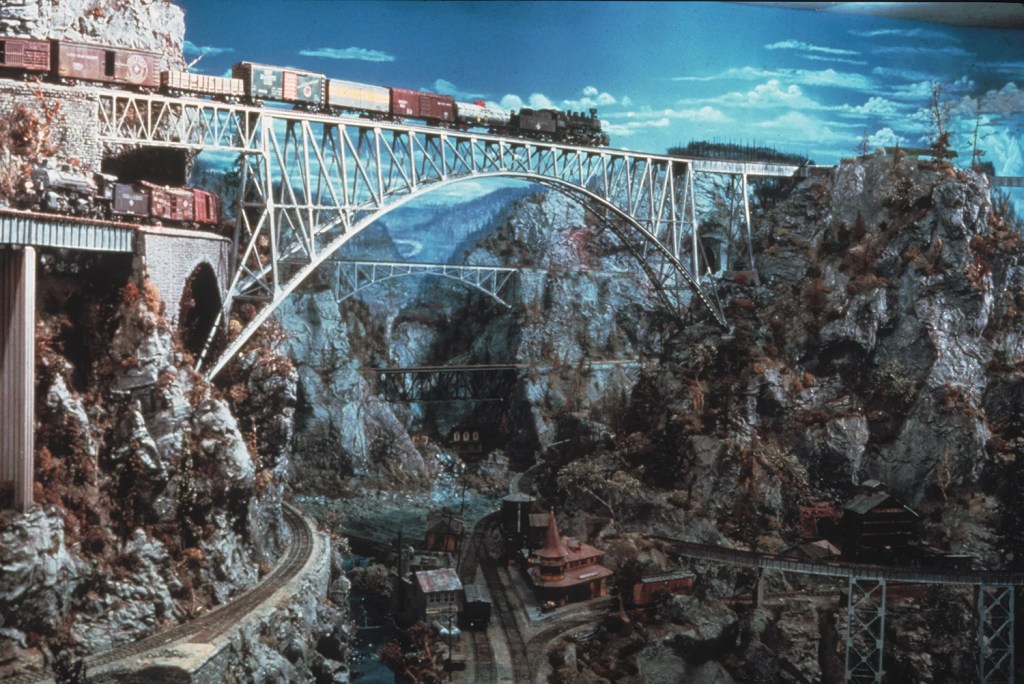
I’ve lately been contemplating layouts that showcase the spectacle and “wonder” of model railroading. I’ve been interested in this sort of modeling ever since I saw Malcolm Furlow’s large scale “Mexican Hat Canyon” in Model Railroader back in 2003. Granted, my interest in this approach has always been a sort of admiring from afar, especially since 2014 when I re-entered the hobby and found myself firmly in the school of Lance Mindheim and small, achievable switching layouts. However, the fascination has never quite gone away. It was renewed when I visited the incredible Minature Wunderland attraction in Hamburg, Germany in 2020, weeks before the pandemic struck:

I think this interest may have remained dormant or simply an “admiring from afar” aspect of the hobby for me. But simultaneously, as my time for chasing obscure locals, spurs, and short lines faded, my appreciation for big trains barreling by on a mainline grew. Simply put, I became more enamored with the gravitas of railroading, and thus, became more fascinated with these hobby greats who portrayed the “big-ness”, spectacle, and magic of railroading.
The greats are easy to count off… John Allen of course. And John Armstrong and Frank Ellison. But one of the earliest pioneers, Minton Cronkhite, has really stood out to me. Cronkhite showcased the “big-ness” of railroading with sweeping curves and wide open scenery.
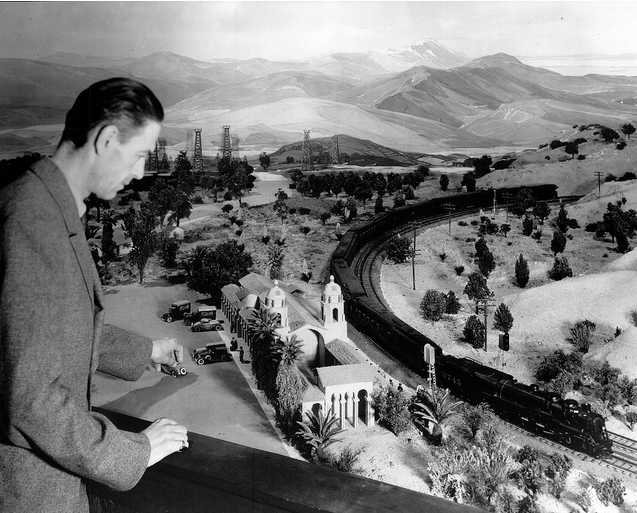
Come to think of it, Minton Cronkhite’s work doesn’t seem THAT different than early iterations of David Barrow’s famed Cat Mountain & Santa Fe…
Now, people will quickly decry the size factor. These layouts were big, and size contributes to the presence they have. But I think there are modest sized examples of this sort of modeling, particularly in the present day.
Dave Meek’s Thunder Mesa layout and associated projects showcase what’s possible with magical, whimsical scenery in a modest space. Vic Smith’s “City’s Edge” is a single large scene in a relatively modest, achievable space. And I’m a big fan of FreestyleMoba on YouTube… the Germans seem to know how to combine modern modeling techniques with layout design oriented towards a spectacle.
Still, I think this sort of modeling is on the wane. And perhaps with good reason. Scenery with this particular kind of gravitas is a commitment of years and likely not easily portable. As our trains have improved, so have operations and the way we interact with layouts has fundamentally changed over decades. Slow running, highly detailed models with ever-improving sound decoders help us experience the size and presence of trains in different ways than silent trains with DC controls winding through plaster mountains.
Still, I wonder if, like Polaroid cameras and record players, a more traditional look at layout design isn’t due for a renaissance. Not without a modern flavor of course. For me, I look hard at Minton Cronkhite’s pioneering work, combined with the more modern influence of David Barrow, and wonder if something similar is achievable in a modest space in N scale… or maybe an updated take on Malcolm Furlow’s San Juan Central project layout? An of course, Iain Rice’s designs, while small and switching focused, tend to incorporate a bit of the “wonder” factor.
Food for thought indeed…















 Red Dirt and Rails